Tuesday, November 26, 2013

Flamenco Dance in Spain

Flamenco is a form of Spanish folk music and dance from the region of Andalusia in southern Spain. It includes cante (singing),toque (guitar playing), baile (dance) andpalmas (handclaps). The top performance has the dancer(s) lead the singing and music.


I visited the Museo del Baile Flamenco via a private tour and then watched a performance in the museum there after.  The museum was found by Christina Hoyos and the tour offered an experience for all the senses with ambiental music, videos, touch-screens and artifacts to be found in this 18th century building at the heart of the historical Barrio Santa Cruz.

The Flamenco Dance Museum in Seville is the principal reference of the Andalusian cultural heritage, which makes understand and feel the union between culture and flamenco art, it is considered therefore as the temple of the Andalusian flamenco culture. The performance was superior.

I watched a different style of Flamenco in Granada in a cave on an intimate stage. However, the performance was rather disappointing. The dancer was slightly out of shape, and did not quite syc with her own or the music rythem. She tried to supplement her slower than standard taps with hand movements which were neither tasteful or powerful. Her second dance was better, but still more of a show than art comparing with the dance in Seville Flamenco museum.


Tip based walking tour in Seville (place for retirement?)

Let me begin by saying that Seville is a wonderful city for retirement, in my view. I will look into the tax and other considerations to see the possibility to retire there 3 months a year.

The tour guide was an unemployed mechanical engineer graduated from the local university which produces 100,000 graduates while the unemployment rate is 36%. A lot of the graduates went working for other EU countries, such as Germany. I heard several editions of Planet Money on Spain economy Robles but only the tour guide mentioned thus reminded me of the problem. The general public in Spain do not want to discuss such issues among themselves, much less with tourists.

The guide explained the ups and downs of Seville along with the come and gone of wealth from the discovery of the America. At the worst time, several uncles were starved to death, and the local population was down to 50,000. 

Even today, there is big wealth differences. A modernized apartment unit costs 150,000 euro owned by the general public, while a much smaller and older unit in another building clustered with the rich costs over one millions. 

The poor is working or try to find work to support themselves. Seville is thus relatively safer than other major cities in Spain. I followed his advice and found one small and outdated looking restaurant out of the old town. The price was half, the portion was twice as much, the food was much more tasty, and people were nice and friendly. I paid only 4.5 euro for chickpea spanish, pork, olives, bread, and a glass of house white wine.  While I ordered two tapas, each of two older gentlemen only ordered one tapa. I suspected that was because if their financial hardship from the unemployment. 

The guide pointed out an suspended high rise near by which costed 300 million euro that was supposed for public housing. The politicians used the money for office instead. I told him the problem could be solved by converting the building into codomilions with Chinese money. He thought the government was too slow and stubborn for such idea, but he was wrong. 

I later read Fromm CNN money: 

LONDON (CNNMoney)
A growing number of wealthy foreigners are buying their way into Europe as hard-pressed countries trade their passports for cash.
Spain, Portugal, Greece and Cyprus, which have suffered the most from the region's prolonged recession, are offering visas to foreigners who buy real estate. The goal is to lure investment and strengthen battered European economies.

The minimum outlay ranges from €250,000 (about $340,000) to€500,000.

I will reevaluate the pros and cons between living in South America and Southern Europe. 


Sites visited after tour in Seville

  • Plaza de España is the site of the Spanish pavilion from the 1929 exhibition. In more recent years it was used in the filming of the new Star Wars episodes. It is somewhat in need of repair. Visit it early in the morning on a weekday to see a long line of immigrants outside one of the government offices it now houses, or visit it right before it closes (officially at 10PM but likely half an hour later) to see it completely empty and rather eerie.
  • Parque María Luisa was built for the 1929 Iber-Americano World's Fair and now is landscaped with attractive monuments and museums.
  • Universidad de Sevilla was once the Tobacco Factory of Seville and was constructed between 1728 and 1771 by Sebastián Van der Bocht. Over the main entrance, the triangular façade ends in a statue of La Fama (fame). The tobacco factory was then the largest industrial building in Spain. A monopoly assured high income, which is reflected in the factory's architecture and surrounding Gardens. Its chapel and prison complement the main building. In the interior you find impressive stairways, fountains and Patios. It was the setting for the first act of Bizet's opera Carmen. In 1953 the factory was converted into the main building of Seville University. Just behind the tobacco factory, the (9) María Luisa park borders the historic center of Seville to the south.
  • The Real Alcázar is a beautiful palace in Mudéjar (Moorish) style, built in the XIV Century by Pedro I the Cruel. With its myriad rooms, extravagant architecture, lavish gardens with many courtyards, ponds and secrets to be explored, it is a fascinating place to visit. Be sure to check out the room where Christopher Columbus's journey to the Americas were planned. You can see his coat of arms embroidered on the wall along with many other royals. In the heat of summer it offers a cool retreat from the suns glare and can quite easily keep visitors occupied for a few centuries.
    • The Jewish Quarter (Barrio Santa Cruz) is located around the Cathedral. It is filled with small winding streets and is generally regarded as the most charming part of the city, but it is also fairly touristy.
    • Castle of Saint George


Monday, November 25, 2013

Seville, Spain

Seville is the capital of Andalucia and the cultural and financial center of southern Spain. A city of just over 700,000 inhabitants (1.6 million in the metropolitan area, making it Spain's 4th largest city). I joined two other backpackers walking from the hostel to Cordoba bus station to get to Seville. 

We got maps from the local information office, and then went to our separate hostels in the old town. One is very close to the bus station, one offers free sangria, and my was next to the Cathedral of Seville.


The Cathedral of Seville was once judged the third largest church in the world after Saint Peter's in Rome and Saint Paul's in London, it is now arguably the largest church in the world when compared using the measurement of volume. Seville's fifteenth century cathedral occupies the site of the former great mosque built in the late twelfth century. The central nave rises to an awesome 37 meters over a total area of 11,520 square meters. The Cathedral is the final resting place of the remains of Christopher.

I was lucky to arrive on Monday when a few facilities in Seville are free. I visited the Cathedral of Seville, the Golden Tower of bulge Neval Museum, and the Bullfighting Arena for free. I was do exhausted and had a fix tapa set for dinner with a glass of sangria. 

The Torre del Oro (English: "Gold Tower") is a dodecagonal military watchtower in Seville, southern Spain, built by the Almohad dynasty in order to control access to Seville via the Guadalquivir river.

Seville is known for its tapas. "Tapa", while it is associated with certain dishes, is actually a size and many restaurants or bars will offer atapa1/2 ración (half serving, although sometimes enough to make a meal) andración (serving) of the same dish. 

I ate at a great tapas place around the foot of the cathedral in the center of town. My five-tapa set included tortilla española (potato omelet), pulpo gallego (Galician octopus), patatas bravas (spicy potatoes), pork, and seafood rice. 


Saturday, November 23, 2013

Cordoba, Spain

Cordoba is a mid-sized city of 350,000 inhabitants and a cultural reference point in Europe. This ancient city has been declared a World Heritage Site and contains a mixture of the diverse cultures that have settled it throughout history.

I book the bus ticket online, asked around for my bus platform, waited in cold over 1 hr for the bus, and then tode 5 hr in the bus to get there.

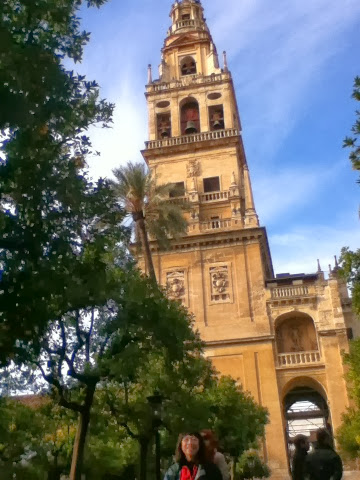
Very few places in the world can boast of having been the capital of a Roman province (Hispania Ulterior), the capital of an Arab State (Al-Andalus) and a Caliphate. Such splendor is palpable in the intellectual wealth of this city, that has seen the birth of figures like Seneca, Averroes, and Maimonides. The historic quarter of Cordoba is a beautiful network of small streets, alleys, squares and whitewashed courtyards arranged around the Mezquita, which reflects the city's prominent place in the Islamic world during medieval times.

The biggest attraction in Cordoba and a truly must-see building, the Mezquita is a massive former mosque-turned-cathedral famed for its "forest" of columns topped with Islamic-style red and white striped arches among its other many architectural highlights and serves as a reminder of the glory and importance Cordoba held in medieval times. 

Entering the interior, there is a forest of columns which recede into the distance, topped with their dazzling horseshoe arches. The light in the space will play interesting tricks with the arches and varies pretty dramatically as you walk through the building, going from rather dark when entering to very bright at the cathedral in the middle and back and forth as continuing. 

At the center of the building, the Cathedraltowers over the rest of the building, and the transition from the impressive-but-intimate mosque structure to the overwhelming awe of the cathedral is abrupt and rather jarring, but don't let that stop you from taking in the beauty of the cathedral, with its rich decoration and well-illuminated interior, standing to suggest triumph over the Muslims who previously used this building. The presence of the cathedral also offers the unique opportunity to so easily compare the differences between Muslim and Christian architecture.

Plaza del Cristo de los Faroles Cuesta del Bailio (Close to Alfaros street). The most impressive square, the best time to go there is the sunset or night (see picture). A Christ in the Cross statue adorned with lot of old lanterns, candles and flowers in a very quiet atmosphere.

Plaza de las Tendillas.